Home » Food consumption in Europe: trends across 12 countries
Food consumption in Europe: trends across 12 countries
From simple ingredients and convenience to protein and affordability: European consumers share common needs, but their priorities vary across markets
What are European consumers looking for when they buy food today? There is no single answer. Health, taste, convenience, ingredient quality and price all influence purchasing decisions across the continent, but their relative importance varies according to local food cultures, economic conditions and consumer expectations.
Analyses published by *FoodNavigator* in 2026, alongside research from market intelligence firms and industry observatories, reveal a diverse picture of how consumers across Europe are redefining their relationship with food.
Convenience is not enough
Saving time is one of the most widespread consumer needs. Ready-to-eat meals, easy-to-prepare foods and products suited to increasingly busy lifestyles address a clear demand. However, speed alone is not enough to make a product appealing.
In Italy, the search for convenience goes hand in hand with attention to ingredient naturalness and food composition. According to figures reported by *FoodNavigator*, approximately 59% of Italian consumers look for meals that are quick and easy to prepare, while 45% pay attention to natural ingredients and 81% say they seek to moderate or avoid their consumption of ultra-processed foods.
In Spain, convenience also coexists with a focus on product composition and familiar flavours. In the Netherlands, market analysis points to interest in chilled solutions that combine convenience with perceived quality.
The common thread is clear: convenience meets a practical need, but it must also deliver on taste, quality and trust.
Health and protein
Health continues to shape food choices, but consumer expectations are becoming more nuanced. Protein remains an important consideration in certain categories and consumer groups, although it is not an equally strong priority across all European markets.
In France, attention extends to protein quality: according to figures reported by *FoodNavigator*, 54% of consumers say they pay attention to it. In Germany, interest in a wider range of protein sources coexists with signs of fatigue around the emphasis placed on high-protein foods. *FoodNavigator* reports that 64% of German consumers believe high-protein foods receive too much attention.
In the Netherlands and Ireland, the conversation also encompasses fibre, gut health and functional foods. The focus is not simply on the presence of a particular nutrient, but increasingly on the benefit a product is expected to deliver as part of everyday eating habits.
Ingredients, origin and transparency
Ingredients remain central to consumer expectations, although priorities differ from one market to another.
In France, local sourcing and ingredient quality are associated with trust and support for domestic agriculture. In Denmark, product origin is particularly relevant in certain categories, especially dairy. In Germany, tradition and familiarity can help make a product feel reassuring in a changing food landscape.
In Italy, attention to natural ingredients goes hand in hand with a stated intention to moderate or avoid ultra-processed foods. In Spain, 45% of consumers say they feel guilty when eating ultra-processed foods. This highlights the role of personal perceptions in the relationship with food, although it does not necessarily translate directly into purchasing behaviour.
Less meat? It depends
Meat consumption habits are also evolving differently across European markets. Importantly, what consumers say they intend to do does not always match actual consumption trends.
In the Netherlands, flexitarian eating has gained ground. According to Euromonitor data reported by *FoodNavigator*, the share of flexitarian consumers rose from 12.9% in 2020 to 15.3% in 2025.
In Spain, 46% of consumers who eat meat say they have reduced their consumption. This does not necessarily mean adopting a vegetarian diet: it may involve smaller portions, more meat-free meals or greater variety in protein sources.
Italy also shows a stated tendency to reduce meat consumption. According to a European survey published by ProVeg International, 59% of Italian meat consumers say they are reducing their annual meat consumption. Actual consumption data, however, present a more complex picture. In 2025, according to Ismea, apparent per-capita consumption of poultry rose from 22.1 to 23 kg, while the figure for pork and cured meats increased from 27.2 to 27.6 kg.
In France, an Insee survey conducted in 2025 found that 48% of the population limits its consumption of red meat, while a further 22% say they do not eat it or consume it only rarely. Health and cost are among the main reasons for reducing consumption. Yet the broader market tells a different story: according to FranceAgriMer, total meat consumption in France rose by 1.3% in 2025, following growth of 2.4% in 2024, with different trends across individual meat categories.
Denmark presents a different picture. Market analysis indicates that the availability of plant-based alternatives has not automatically translated into a significant decline in overall meat consumption.
The overall picture is therefore more complex than a straightforward shift towards eating less meat. **Reducing consumption of certain types of meat does not necessarily mean reducing total meat consumption.** Understanding changing habits requires looking at which categories people buy, how frequently they consume them and how preferences shift between different protein sources.
Affordability takes different forms
Economic pressure continues to influence food shopping across Europe, shaping how households plan and manage their spending.
In Portugal, NielsenIQ analysis points to more frequent shopping trips and lower spending per occasion, resulting in smaller baskets. In Poland, the need to manage household budgets goes hand in hand with a renewed focus on home cooking and fresh foods. According to PwC, 59% of Polish consumers identify price as a priority when making purchasing decisions.
In Sweden, private-label products and value for money play an important role, including in categories linked to emerging food trends. In Belgium, YouGov data highlight the importance of promotions and cost-saving strategies in everyday grocery shopping. In the fourth quarter of 2025, the fast-moving consumer goods market grew by 0.4% year on year in value; growth for the full year reached 1.8%. These figures describe market value, not necessarily an increase in the volume of products purchased.
In the UK, the desire for familiarity and nostalgia coexists with curiosity about new experiences. According to figures reported by *FoodNavigator*, 62% of seasonal food and drink shoppers say they choose products that remind them of childhood, while 70% of consumers appreciate food and drink products that offer new experiences.
Consumers are not necessarily looking for the lowest price on every occasion. The value of a food product also depends on what they believe they are getting in return, in terms of quality, convenience, taste and satisfaction.
Twelve markets, twelve consumer profiles
The findings point to distinct profiles that summarise the prevailing trends in each market.
– **ITALY — Simplicity, naturalness, convenience.** Consumers want to save time while paying attention to ingredients and food composition.
– **FRANCE — Quality, origin, protein.** Consumers value natural ingredients, pay attention to provenance and increasingly distinguish between protein sources.
– **GERMANY — Protein, tradition, familiarity.** Consumers are interested in dietary diversification but may be wary of the excessive emphasis on nutritional trends.
– **SPAIN — Convenience, taste, flexibility.** Consumers look for practical solutions, maintain a strong connection with familiar flavours, and some are reducing their meat consumption.
– **UNITED KINGDOM — Nostalgia, novelty, experimentation.** Familiar childhood flavours coexist with curiosity about new food experiences.
– **THE NETHERLANDS — Functionality, quality, flexibility.** Consumers are interested in nutritional benefits and more flexible approaches to protein consumption.
– **IRELAND — Wellbeing, protein, affordability.** Consumers show interest in functional foods while also considering price and clear product information.
– **SWEDEN — Price, functionality, sustainability.** Consumers seek value for money without overlooking environmental considerations.
– **DENMARK — Provenance, dairy, enjoyment.** Local quality and familiar products matter, without necessarily implying a move away from meat.
– **PORTUGAL — Savings, targeted shopping, convenience.** Consumers manage spending through smaller, more frequent shopping trips.
– **POLAND — Price, freshness, home cooking.** Consumers seek to control spending while valuing fresh foods and home-prepared meals.
– **BELGIUM — Promotions, affordability, spending control.** Consumers are sensitive to price changes and use shopping strategies focused on savings.
Twelve markets, twelve ways of relating to food. Priorities differ, but the need to balance taste, convenience, quality and price is shared across much of Europe. Understanding these differences means treating trends not as a checklist to replicate across markets, but as signals to interpret in light of local habits and expectations.
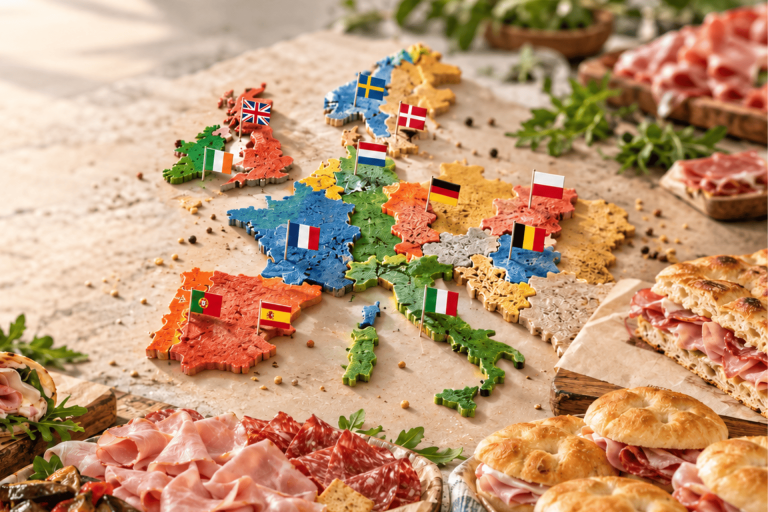
*This image was generated using AI.